
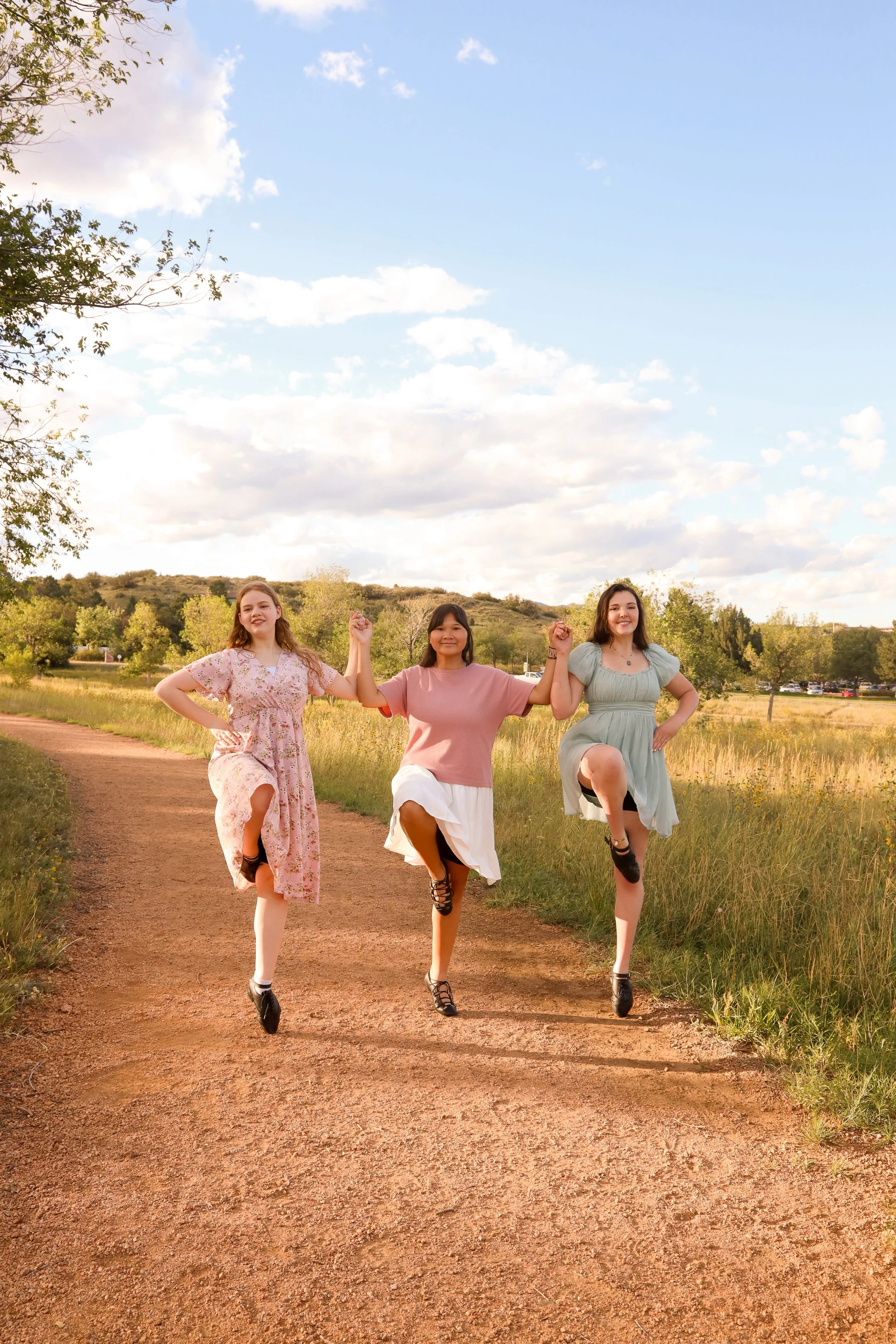
There are plenty of reasons to take up Irish step dancing. In addition to being a fantastic cardiovascular workout, the precise patterns and footwork exercise memory, concentration, and focus. The family-style ceili builds social connections, bringing friendship and teamwork to every class. It’s uniquely versatile with soft shoe (similar to ballet) and hard shoe (similar to tap) styles. More than that, Irish step dancing is one of the best artforms to foster a cultural connection, offering an education rich in both history and technique. Ready to learn more? Let’s celebrate St. Patrick’s Day with a brief history of Irish step dancing, and how you can give it a try at Turning Pointe Dance.
With roots in Celtic and Druid circular dances dating back to 1700s Ireland, Irish step dancing has developed over centuries into a highly athletic and technical style. But not without plenty of folklore and challenges! During the 17th and 18th centuries, the British colonization of Ireland led to the prohibition of Irish culture. As a result, traditional folk dancing went mostly underground. Dance teachers were forced to teach the then-outlawed dance in secret in order to keep the artform alive. Like most of Ireland’s ancient culture, the origin and evolution of this particular dance style is widely speculated, but there are known accounts of Irish step dancing being practiced in secret on tabletops or in small spaces, contributing to the style’s trademark rigid upper-body style.
Between 1778 and 1829, the Catholic Relief Acts began to implement the end of cultural restrictions—a process still unfolding as recently as last year. As a result, traveling teachers known as “The Dancing Masters” began touring Ireland, moving village-to-village, standardizing dance steps, and fostering a culture of uniformity and competition among dancers. From these newly-solidified steps—and the foundation of The Gaelic League, an Irish nationalist body formed with the purpose of preserving traditional Irish language and culture in 1893—traditional folk dancing began to take the shape of the Irish step dancing practiced and performed today. The artform spread globally primarily through 19th-century immigration to the U.S., Canada, and Australia, where it was further popularized through the Gaelic League's promotion and the establishment of formal competitions in the 20th century.
The establishment of the Irish Dancing Commission followed The Gaelic League in 1930, followed by the premiere of the Irish Dancing World Championships in 1970. The World Championships are still competed each year, and typically host approximately 6,000 dancers from more than 30 countries around the world. Modern Irish step dancing enjoyed a massive rise in popularity two decades later when Michael Flatley’s “Riverdance” premiered at Eurovision in 1994. The show went on to achieve worldwide success during its remarkable 15 year run, successfully introducing a whole new generation to traditional Irish dance.
Today, Irish step dance has evolved from a post-Riverdance cultural phenomenon into a highly athletic, globally recognized, and digital-era performance art. The fast development of media and technology, coupled with the dance industry’s necessary shift into digital content creation during the 2020 pandemic, have made significant strides in keeping this tradition and culture relevant. And with social celebrities like The Gardiner Brothers, whose viral jigs have accumulated more than 3.6 million followers on TikTok and another 1.7 million on Instagram, the future of Irish step dance is seemingly in good hands.
Ready to give it a try? Here are some opportunities coming up at Turning Pointe Dance!
Irish Step Dancing at Turning Pointe Dance
Fast track registration for 2026-27 school-year session classes runs May 15 – June 1. Open registration begins July 15.
Irish Demo and Free Community Classes:
● Monday, March 23: 1 p.m., Cheyenne Mountain Library (1785 S 8th St. #100, 80905)
● Wednesday, March 25: 9:30 and 11 a.m., PPLD East Library (5550 N. Union Blvd. 80918)
Six-Week Summer Session (June 8 – July 16, 2026):
● Irish 1/2: Mondays, 4-5 p.m.
What to Expect:
Irish Step Dance at Turning Pointe is a fun and fast-paced class that emphasizes the rhythms of beautiful celtic music with a unique technique all its own. Dancers will learn that technique through warm up exercises, across the floor work and traditional folk dances including the jig, reel and hornpipe, which all focus on very specific footwork. They will also participate in group dances called Ceilis, which develop teamwork skills and coordination. Students will learn choreographed work that combines all the elements they learn within the class, performed at the studio’s annual spring recital in May.
Students should plan to wear a solid-color top and black leggings. Ankles must be visible. Black ballet shoes or black ghillies preferred. Black tap shoes for hard shoe class (needed for ages 9 and up, not for Irish 1/2 class). Traditional Irish hard shoes are encouraged for Irish 4 and 5, optional for Irish 3.